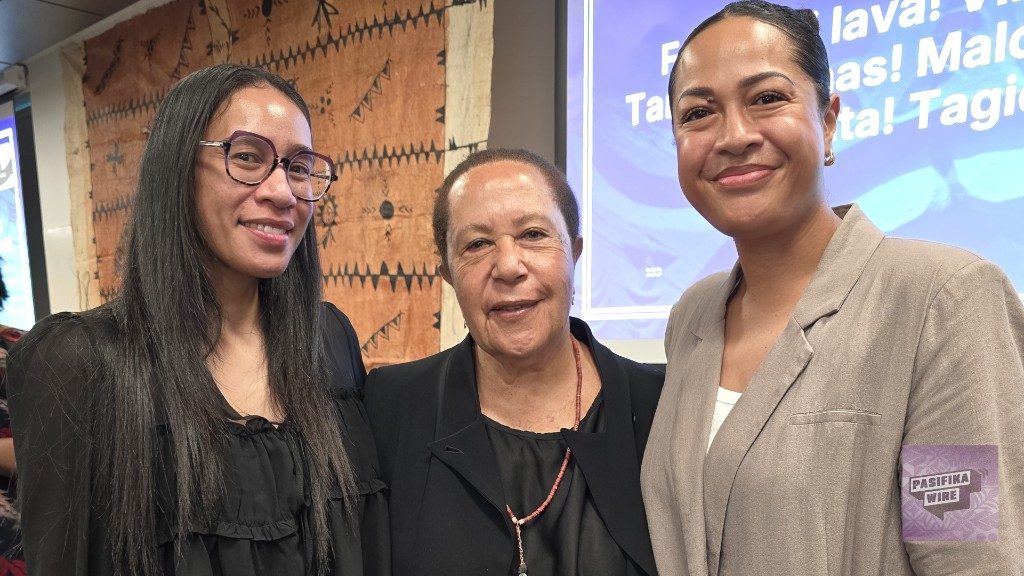
Delivering the Olive Malienafau Nelson Public Lecture 2026, is the first Pacific woman to be Secretary General of the Pacific Islands Forum, Dame Meg Taylor, DBE who held the post for six years between 2014 – 2021.
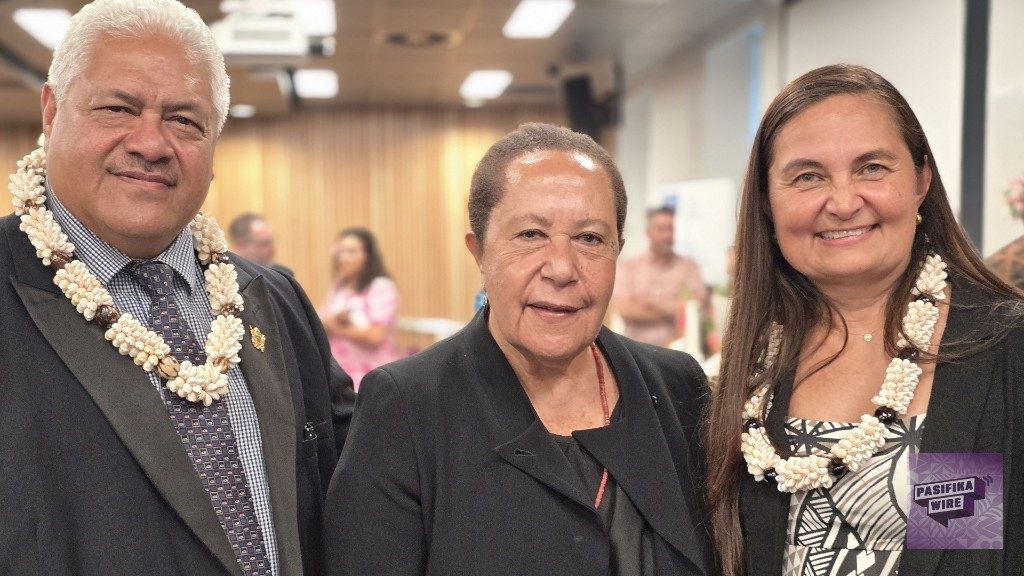
It was a unique opportunity to hear from Dame Meg who is widely respected and considered to be an expert on the geopolitical history and landscape of the Pacific region. The lecture was attended by former Deputy Prime Minister and former Attorney General of Samoa, Tugaga Lesamatauaunuu Misa Telefoni Retzlaff, former Secretary General of the Pacific Islands Forum and Judge of the International Criminal Court, Tuiloma Neroni Slade and Cook Islands Consul-General to New Zealand Keutekarakia Mataroa.
Also in attendance were founders of the Olive Malienafau Nelson Scholarship, La’auli Sir Michael Jones and Olive’s granddaughter Lady Maliena Jones.
Dame Meg covered a wide range of subjects during her 45-minute lecture, diving into historical events and the geopolitical posture of the Pacific region over the past five decades as Pacific nations continue to champion the voice of the Blue Continent across the globe on issues of sovereignty, legal rights, ownership, self-determination, ocean stewardship, security, and climate change.
From Papua New Guinea, the renowned diplomat has held significant roles over the years representing not only her country but also the Pacific region on the international stage. She was made a Dame Commander of the Order of the British Empire.
With a Bachelor and Master of Laws, Dame Meg has held positions such as Ambassador of PNG to the United States, Mexico and Canada based in Washington DC, and also served on the high-level United Nations steering committee on Every Woman and Every Child.
During the lecture she explored the history of the region and its roots in the ‘oceanic realm that predated European discovery’. She discussed challenges of the past with examples of leadership and ingenuity of Pacific nations who held fast to the traditions and beliefs of the Pacific and used existing legal tools and frameworks to challenge those who sought to defy it.
Dame Meg says her hope is, “for a resilient Pacific region of peace, harmony, security, social inclusion, and prosperity to ensure all Pacific people can lead free, healthy and productive lives.”
She touched on how art, music, dance and oral traditions flourished, serving as a means of passing down knowledge, history and values through generations.
Exploring the era of colonisation, she turned her attention to the ‘European powers of the time who were motivated by the quest for territory and resources, emboldened by racial prejudice and a civilising mission” that embarked on expeditions reshaping the region irrevocably.
Discussing the impacts of this colonial period Dame Meg shared, “it can be sometimes downplayed as benign in historical narratives. They should not be because we bear scars that speak otherwise” from the practice of ‘Blackbirding’ from Solomon Islands and Vanuatu, Phosphate mining that fueled the growth of many nations, particularly Australia and New Zealand, to the detriment of the islands of Banaba and Kiribati, and the unchecked nuclear testing carried out by Britain, France and the United States. With the USA carrying out 67 tests in the Marshall Islands, while France carried out 193 in French Polynesia.
Dame Meg says while the region endured challenges, it was never passive, stating that as early as the 19th century, King Kalakaua of Hawaii advocated for confederation of Pacific states and mentioned the rebellion in Fiji and the Mau movement in Samoa that challenged colonial authorities and asserted indigenous political futures.
Dame Meg acknowledged leaders of the past such as Ratu Sir Kamasese Mara, Tupua Tamasese Lealofi IV, Sir Albert Henry and Sir Michael Somare, who initiated the creation of the South Pacific Forum in 1971, now the Pacific Islands Forum
She says the forum crystallised under the idea of a ‘Pacific Way’. From the 1970s Pacific states began to play a pivotal role shaping the emerging international league of order of the oceans through sustained participation in the negotiation and adoption of the United Nations Convention on the Law of the Sea (UNCLOS).
She highlighted the regional establishment of treaties such as the 1985 treaty of Rarotonga, a cornerstone of international law on nuclear disarmament and non-proliferation, the Forum Fisheries Agency in the face of local opposition from major fishing and maritime powers, and the South Pacific Regional Environment Programme (SPREP), tasked to govern living marine resources.
Dame Meg talked of her term as SG where a Framework for Pacific Regions was established to restore political ownership and re-balance relationships between members and return the Forum to its core purpose. This led to the 2017 declaration of the Blue Pacific Continent, and establishment of its 2050 Strategy, a long-term framework for sustainable development.
She stated that international law is vital to pursue goals such as the 1.5° temperature goal in the 2015 Paris Agreement, and member states turning to international courts and tribunals to seek “clarity, response, responsibility and justice” giving the example of Vanuatu’s initiative to request the advisory opinion from the International Court of Justice marked a decisive moment in this strategy.
Other measures mentioned were The High Ambition Coalition to End Plastic Pollution which seeks a strong and legally binding global treaty for the protection of ocean ecosystems, and in 2021, forum leaders adopted the Declaration on Preserving Maritime Zones; asserting that maritime boundaries established in accordance with AUKUS must remain permanent despite sea level rise, all demonstrating how “small states acting collectively can shape the development of international law itself.”
Dame Meg also highlights the recognition of women with the Gender Equality Declaration by the Pacific Islands Forum in 2024 saying it “marks an important milestone, where we as Pacific peoples must now recognise and act for the women of future generations.”
In closing, Dame Meg says vulnerabilities still exist. Despite the history of strong regional governance and collective action, the Pacific remains “profoundly vulnerable through its continued reliance on external funding” creating not only “financial fragility but political risk. A risk to autonomy, to coherence and to the integrity of our regional voice” and believes there exists “a need to redouble our efforts to assert our unified Pacific narrative.”
Dame Meg’s lecture invited us all to take up that torch; to continue to build on the work of the ever-changing landscape of the Blue Pacific Continent.
The University of Auckland Pacific Island Students’ Law Association hosted the Olive Malienafau Nelson Public Lecture 2026. The lecture honours Olive Malienafau Nelson, the first Pacific woman to graduate from the University of Auckland with a Bachelor of Laws degree.